

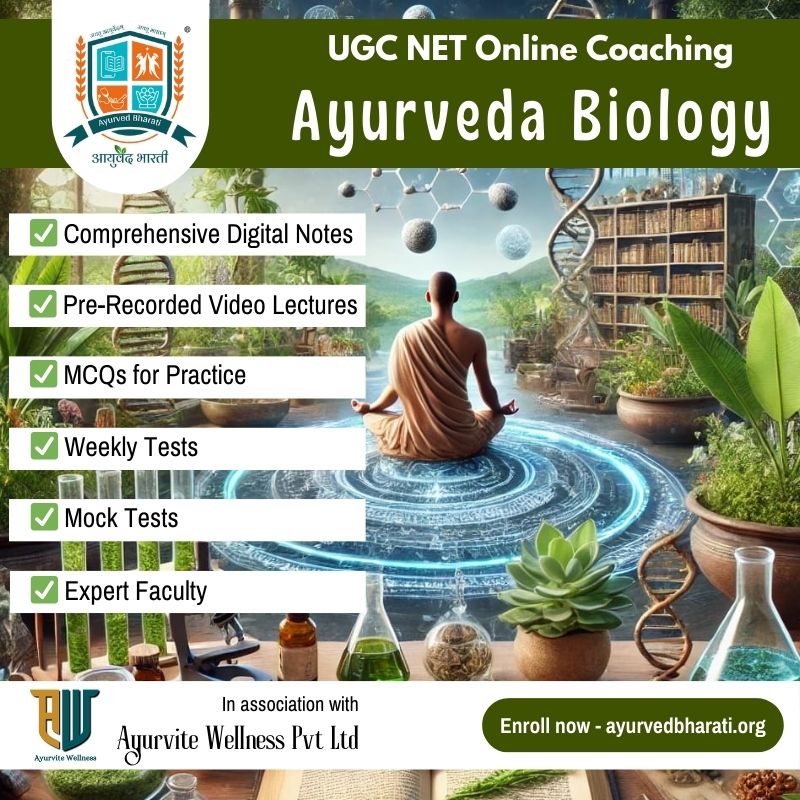
Join our Online UGC NET Ayurveda Biology Coaching with Expert GuidanceThe UGC NET Ayurveda Biology is a newly introduced subject starting from the December 2024 cycle. With its unique blend of Ayurveda and biology concepts, it opens new doors for aspirants aiming to excel in academia and research. To help you ace this exam, we present our online coaching program, meticulously designed to cover every aspect of the syllabus. Table Of ContentsWhy Choose Our Coaching Program?Course HighlightsDetailed Syllabus CoverageUnit 1: History and Development of AyurvedaUnit 2: Philosophy and Fundamental Principles of AyurvedaUnit 3: Sharira Rachna and KriyaUnit 4: Padartha Vijnana and Dravya VijnanaUnit 5: Rasa Shastra, Bheshajya Kalpana, and Ayurvedic PharmacopeiaUnit 6: Disease Biology, Microbiology, and ImmunologyUnit 7: Genetics, Ayurgenomics, Cell, and Molecular BiologyUnit 8: Physiology, Biochemistry, and NanotechnologyUnit 9: Biodiversity, Environmental Health, IPR, and EntrepreneurshipUnit 10: Research Methodology, Biostatistics, and Ayurveda-InformaticsWhy Start Preparing Now?Enroll Today for UGC NET Ayurveda Biology Coaching!Course Keywords:Frequently Asked Questions (FAQs) on UGC NET Ayurveda Biology CoachingWhy Choose Our Coaching Program?✅ Comprehensive Downloadable Digital NotesAccess detailed and concise notes crafted by experts, ensuring clarity and ease of understanding. You can read it online, download in your device as pdf. These notes are in English.✅ Pre-Recorded Video LecturesLearn at your own pace with engaging video sessions that explain complex topics in simple terms. The video lectures are in Hindi (majorly).✅ MCQs for PracticeStrengthen your preparation with an extensive collection of multiple-choice questions covering all syllabus topics.✅ Topic wise TestsEvaluate your progress with topic-wise assessments to identify and improve weak areas.✅ Mock TestsSimulate the actual exam experience with full-length mock tests designed as per the latest pattern.Course HighlightsCourse enrollment open for: UGC NET June/ December examMode: 100% OnlineValidity: 1 yearMedium: Video Lectures in Hindi majorly, downloadable digital notes in English, Test Series in EnglishExpert Faculty: Experienced professionals with a deep understanding of Ayurveda and biology.Detailed Syllabus CoverageUnit 1: History and Development of AyurvedaVedic origin & chronological development of ĀyurvedaĀyurveda and various schoolsUnderstanding and relevance of aṣṭāṅgaāyurvedaBasic Texts and commentaries of ĀyurvedaContribution of commentators to ĀyurvedaIntroduction to bṛhattrayī and its importanceIntroduction to laghutrayī and its importanceBasic understanding of nighaṇṭu and kośa of ĀyurvedaContribution of contemporary publications in ĀyurvedaGovernment initiatives for development of ĀyurvedaUnit 2: Philosophy and Fundamental Principles of Ayurvedaāyu – lakṣaṇa, paryāya, paribhāṣā and pramāṇaDefinitions of śarīra, jñānendriya, karmendriya, mana, buddhi, citta, ahaṃkāra, ātmālokapuruṣa sāmya siddhānta, ekadhātu puruṣa, ṣaḍdhātuja puruṣa, caturviṃśatitatvātmaka puruṣa and their relevanceDefinitions of Ayurveda – hitāyu – ahitāyu, sukhāyu – dukhāyu, trisūtra āyurveda – hetu-liṅga-auṣadha-jñāna svastha āturasvāsthya lakṣaṇa – – Dimensions of Health Corresponding to nature, prakṛti, ṛtucaryā,dinacaryā, svasthavṛttapaṃcamahābhūta – ākāśa-vāyu-agni-jala-pṛthvī and their specific propertiesTheories of sāmānya and viśeṣapadārtha – theories of dravya-guṇa-karma-sāmānya-viśeṣa-samavāyadoṣa – śarīrika and mānasikaIntroduction to dhātu, mala, agni and srotasUnit 3: Sharira Rachna and KriyaIntroduction to śarīra racanā kriyāgarbhaśarīra (fetal development) – śukra, ārtava, garbhādhāna, garbha andmāsānumāsika garbhaIntroduction to śarīra pramāṇa, saṃkhyā śarīra, aṅga-pratyaṅga-koṣṭhāṅga and āśayaIntroduction to deha prakṛti and mānasa prakṛtiIntroduction to doṣa, sapta dhātu and mala vijñānaDefinition and types of – asthi, sandhi, snāyu, peśī, parva and kaṇḍarāDefinition, types and numbers of srotas, dhamanī, śirā and nāḍīojas and its importanceDefinition of agni and types – jaṭharāgni, dhātvāgni and bhūtāgnimarma – Definition and typesUnit 4: Padartha Vijnana and Dravya Vijnanapadārtha – Definition and types – saptapadārthaDefinition and types of pramā, prameya, pramātā, pramāṇa and pramāṇa catuṣṭayapramāṇa – Definition and types – āptopadeśa, pratyakṣa, anumāna and yukti pramāṇaOrigin of dravya, Definition and types – kāraṇa and kārya dravyaauṣadha and āhāra dravya, āyuṣya – anāyuṣya dravyaBasic concept of rasa pañcakadravya – nāma-rūpa-guṇa-karma-yoga-prayoga-saṃyoga vijñānaBasic concept, classification, and application guṇa, vīrya and vipākaBasic concept of karma and its classificationdravya in accordance with karma and its uses in health and diseaseUnit 5: Rasa Shastra, Bheshajya Kalpana, and Ayurvedic PharmacopeiaRasa Shastra and bhaiṣajyaKalpana:Origin and Development of rasa śāstra and bhaiṣajya kalpanārasa – Definition, Types of rasa śodhana prakāra and saṃskārauparasa sādhāraṇa rasa, ratna, and uparatna, – Definition; Types of śodhana and māraṇaPrinciples of auṣadha nirmāṇa, jāraṇa, māraṇa, satvapātana, nirvāpa and āvāpaBasic concept of bhaiṣajya kalpanārasaśālā – Conventional and Contemporary aspects, Good Collection Practices andGood Manufacturing PracticesBasic Pharmaceutical dosage forms and Secondary dosage forms of āyurvedaDefinition of puṭa, its types and use in various pharmaceutical formsauṣadha sevana kāla and auṣadha sevana mārgaPharmacopeia:Āyurvedic Pharmacopoeia of India (API) – Introduction, development and importanceĀyurvedic Formulary of India (AFI) – Introduction, development and importanceDrugs and Cosmetics Act, 1940 in relation to ASU Drugs and Standardization of ASU drugsExtra-pharmacopoeial drugs (Anukta dravya) not finding place in Ayurvedic ClassicsKnowledge of pharmaco-vigilance in Āyurveda and conventional system of medicinePharmacogenomics of active compounds of Āyurveda and multi-omics approachUnit 6: Disease Biology, Microbiology, and ImmunologyDisease Biology:Definition of disease, Etiology and PathologyCongenital and Acquired diseasesCommunicable and Non-communicable diseasesGenetic and Epigenetic factors in health and diseasesAutoimmune diseases and Lifestyle disordersDeficiency and Metabolic diseasesPsychological disordersBenign tumors and various types of cancersMicrobiology:Historical perspectives of Microbiology, Immunization, Epidemics and PandemicsAntimicrobial resistance, Immune response by microorganisms, Sterilization and disinfectionMicrobial Diversity and PhysiologyGut-Brain axis (GBA) and MicrobiomeMicroorganisms isolation and characterization, culture mediaEnvironmental microflora, Bio-remediation, Dairy microbiology, Indicator organisms andtests and water borne diseasesGenetic Recombination, Transformation, Conjugation and TransductionImmunology:Role of RBCs, WBCs, platelets and plasma proteins in immune mechanismsBiophysics of Immune System, Structure of antigen and antibody molecules, Antigen recognition by T cell and B cells, B-cell receptors, TCR gene rearrangement, antigen presentation and MHC/HLA complexAntigen antibody reactions, Innate immune cells, Pathogen-associated molecular pattern (PAMP), Pathogen recognition receptors (PRR) and Complement systemNatural and Acquired immunity, cell-mediated immunity and toxicity and cytokinesImmunopathology and autoimmune diseases, transplant rejection and allergy, ImmunomodulatorsAntibody isolation and purification, ELISA, immunoblotting, immunohistochemistry, immunoprecipitation, immune cell isolation, flow cytometry and ImmunotherapyHistory of vaccines, attenuated vaccine, heat-killed vaccine, subunit vaccine, recombinant vaccine, DNA vaccine, RNA vaccine, dendritic cell-based vaccine, Virus-Like Particles, adjuvants and their role in vaccineUnit 7: Genetics, Ayurgenomics, Cell, and Molecular BiologyGenetics and Ayurgenomics:Principles of Inheritance and Variation, Historical Perspectives of GeneticsHuman genome and its evolutionExploring genotype to phenotype correlation, Multi-OMIC and its correlation with doṣa-prakṛti and medicinal plantsBasics of human genomics, regulatory mechanisms of genetic variation, its role inhealth, diseases and adaptation including drug responsePopulation genomics, Disease genomics, Pharmaco-genomics, Nutrigenomics, and scientific approaches and initiatives towards discovery of biomarkersApproach, limitation and challenges in discovery, development and delivery of P4 and P5 (Predictive, Preventive, Personalized, Participatory and Promotive) medicinal aspects of ĀyurvedaCell and Molecular Biology:Plant and animal cells – Structure and FunctionEarly evidences and Experiments of DNA as the genetic material, Chemistry of Nucleic acids, Nucleotides, Chargaff’s ruleWatson-Crick model and forms of DNA; types of RNAs, Concept of gene and genome, difference between prokaryotes and eukaryotic genes, C-value paradox, Triplexes, quadruplexes and aptamersDNA replication-conservative, semi-conservative and dispersive models, DNA replicative enzymes and mechanisms of DNA replicationTypes of gene mutations – base substitution, frame shift mutation, insertion, deletion, missense, nonsense, reverse, suppressor and lethal mutations; DNA damage and repair mechanismsGene expression and regulation in prokaryotes, structure of prokaryotic gene, structure and functions of RNA polymerase and its subunitsMechanism of Gene Transcription and Translation, Genetic code, Gene structure, expression and regulation in eukaryotes, RNA polymerases, Post-transcriptional modifications and Operon conceptBasic concepts of Genetic Engineering and BiotechnologyUnit 8: Physiology, Biochemistry, and NanotechnologyPhysiology:Fundamentals of human physiology and cellular functionDigestive System – Digestion, Absorption and MetabolismRespiratory and Circulatory Systems – Breathing and exchange of gases, Body fluids and circulationNervous Systems – Central and Autonomic nervous system, Neurophysiology and Cerebrospinal fluidsExcretory and Endocrine Systems – Excretory products and their elimination from the body, acid-base regulation, Endocrine glands and Hormonal functionsReproductive System – Human reproductive physiology and Embryonic developmentVoluntary and Involuntary movements and their coordinationBiochemistry:Concept of atoms and molecules, molecular interactions, stereochemistry and their importance in biological systemsCarbohydrate chemistry and metabolism, Disorders associated with carbohydrate metabolismLipid chemistry and metabolism, Disorders associated with lipid metabolism, LipidomicsChemistry and metabolism of Proteins and Amino acids, Ramachandran plot, primary, secondary, tertiary and quaternary structure of proteins, Mechanisms and specificity ofEnzymes, Coenzymes and Cofactors, Disorders associated with protein and amino acid metabolism, proteomicsHeme synthesis and disordersStructure, function and metabolisms of nucleic acids, DNA and RNANanotechnology:Physical properties and types of the nanoparticles, Nanoparticles of various basic pharmaceutical forms of Āyurveda and Green nanotechnologySynthesis of nanomaterials using different methods, Molecular basis of biosynthesis of nanomaterials, assessment of plant, animal and mineral-based drugs for nanomaterialsCharacterizations of nanoparticles – transmission electron microscope (TEM), scanning electron microscope (SEM), fluroscence microscopy, atomic force microscope (AFM), Energy-dispersive X-ray spectroscopy (EDX), UV – visible absorption; photoluminescence; Fourier-transform infrared spectroscopy (FTIR), Atomic absorption spectroscopy (AAS) and dynamic light scattering spectroscopy (DLS)Nanomaterials in bio-sensors and other applications and Interaction of nanomaterialsMolecular basis of nano-formulationsUnit 9: Biodiversity, Environmental Health, IPR, and EntrepreneurshipBiodiversity and Environmental Health:Biodiversity of Medicinal plants and animals, Concept and Practices of environmental health, Pathways for synthesis of primary and secondary metabolites and their usesPharmacological properties of secondary and active metabolites of medicinal plants used in ĀyurvedaConcept of ecosystem, structure, function and types of ecosystem, energy flow in an ecosystem: food chain, food web and ecological successionBiodiversity and its conservation, Levels of biological diversity, biogeography zones ofIndia, biodiversity patterns and global biodiversity hot spots, India as a mega-biodiversity nationRenewable and non-renewable biological resources and their importance in longevity of lifeDegradation of biodiversity, loss of medicinal plants and animal life, and its impact on indigenous knowledgeIntellectual Property Rights (IPR):Concept, meaning and types of Intellectual Property (IP), Origin, nature, philosophy and importance of Intellectual Property Rights (IPR), Current Best Practices (CBP) and legal framework of IPRProtection of Traditional Knowledge System (TKS), prevention of bio-piracy and bio- prospecting, benefits to national economy, conservation of environment, protection of livelihood of TK stake- holders, TKS and innovation in Indian medicine systemIntroduction to the Indian patent office and National Biodiversity Authority and their role in the protection of TKS, Different types of IPR protection in India, Indian Legislations –Patents Act of India (1970); Biological Diversity Act (2002), Convention of BiologicalDiversity (1992), Plant Protection Variety and Farmers Rights Act (2001) andGeographical Indication Act 1999 etc. with respect to TKSThe role of databases and registers in the legal protection of TKS – TraditionalKnowledge Digital Library (TKDL) through World Intellectual Property Organisation (WIPO)WTO, TRIPS, World Intellectual Property Organisation (WIPO), Convention on Biological Diversity (CBD); FAO; Nagoya Protocol on access and benefit-sharingEntrepreneurship:Definition of Entrepreneur, Entrepreneurial traits, and Entrepreneur versus Manager, Entrepreneurial decision processes, Ethical, Legal and Socio-cultural responsibilitiesOpportunities for Entrepreneurs in relation to food and drugs of Ayurveda for wellnessInnovations and new ideas in Āyurveda R&D, Product planning, development and troubleshooting, Types of Āyurveda industries and manufacturing, and Competitive dynamics between the sub-industriesEntrepreneurship development programs of public and private agencies (MSME, Ministry of Ayush, Make in India), Challenges in Āyurveda industry and decision-making, Patenting and Commercialization strategiesLaboratory to market – strategies and processes of negotiation with financiers, government and regulatory authorities, Pricing strategy, challenges in marketing in Āyurveda business, Distribution channels, supply chain, Analysis and management of customer needsBusiness preparation including statutory and legal requirements, business feasibility study, Financial management in capital procurement and cost management, Collaborations and partnershipUnit 10: Research Methodology, Biostatistics, and Ayurveda-InformaticsResearch MethodologyResearch Methodologies and Bioethics in ĀyurvedaFundamental principles-based research in ĀyurvedaFood and drug-based research in AyurvedaPre-clinical and Clinical trials – types, protocol designing and data management in accordance with the principles of Āyurveda.Various extraction methods of plant materials, Concept of polarity for extraction and Solvents used for the extractionPurification of bioactive compounds through various chromatographic methodsIdentification of Functional Groups in PhytochemicalsBiostatistics:Average, Mean, Mode, Median; Descriptive statistics, Various Statistical tests of significance and Analysis of variancePower and sample size calculation and Basic Principles of Statistical InferenceCorrelation analysis, Regression analysis and Survival analysisGenome Mapping Statistics and BioinformaticsTypes of data and its classification, multi-dimensional data, big data, meta data, linear algebraic treatment to data, matrices, eigen values and eigenvectors, and singular value decomposition.Exploratory data analysis, descriptive statistics and inferential statisticsAyurveda-informatics:Chronological Development of Āyurvedic drug manufacturing industriesGovernment policies and initiatives for the development of Āyurveda as traditional System of Medicine of India for the wellbeing of the worldOrdinance, Rules and Regulations in the manufacturing of quality, safety and efficacy of Āyurvedic drugs for the consumersReview of important modern works on classical medicinal plants published by Ministry of AYUSH and ICMR, Govt of India Important organizations of Ayurveda – National Commission for Indian System of Medicine (NCISM), Central Council for Research in Āyurvedic Sciences (CCRAS), Āyurvedic Pharmacopeia commission, National Medicinal Plants Board and Traditional Knowledge Digital Library (TKDL), etcResearch publication portals in Āyurveda and contemporary medical science – DHARA, PubMed, Ayush Research Portal, Bioinformatics Centre and Research Management Informatic SystemUse of modern technology to confirm the various fundamental principles, drug research and development for communicable and non-communicable diseasesHealth informatics in Āyurveda in present global scenarioWhy Start Preparing Now?With Ayurveda Biology being a new addition to the UGC NET syllabus, early preparation gives you a competitive edge. Our course ensures comprehensive coverage of all topics, empowering you to excel in this exam.Enroll Today for UGC NET Ayurveda Biology Coaching!�� Steps to Enroll:Visit our website and sign up for the UGC NET Ayurveda Biology course.Choose your preferred payment plan.Gain instant access to course materials and start your preparation journey.�� Need Assistance?Please feel free to contact our helpdesk for any queries.Course Keywords:UGC NET Ayurveda Biology CoachingOnline UGC NET Coaching for Ayurveda BiologyBest Coaching for UGC NET Ayurveda BiologyUGC NET PreparationUGC NET Ayurveda Biology Study MaterialUGC NET Ayurveda Biology NotesAyurveda Biology Question PaperFrequently Asked Questions (FAQs) on UGC NET Ayurveda Biology Coaching 1. What is UGC NET Ayurveda Biology?UGC NET Ayurveda Biology is a newly introduced subject in the UGC NET examination starting from December 2024. It integrates traditional Ayurveda knowledge with contemporary biological sciences, providing opportunities in academia, research, and industry. 2. Who should enroll in this course?This course is ideal for aspirants aiming to qualify UGC NET in Ayurveda Biology to pursue careers in teaching, research, or higher education. 3. What is the mode of this coaching program?Our coaching program is 100% online, providing flexibility to learn at your own convenience. 4. What materials are included in the coaching program?You’ll get free comprehensive digital notes, pre-recorded video lectures, extensive MCQs for practice, topic-wise tests, and mock tests based on the latest exam pattern. Also, we have the printed book set for UGC NET Ayurveda Biology preparation which can be purchased separately for a better learning and reduce screen time. Order printed books here. 5. In what languages is the course content available?Video lectures are provided in Hinglish (Hindi-English mix), while digital notes, printed books, and test series are entirely in English. 6. How experienced are your faculty members?Our faculty comprises experienced professionals with deep expertise in both Ayurveda and biological sciences, ensuring high-quality guidance and clarity of concepts. 7. How is the syllabus structured in your coaching program?The syllabus is comprehensively structured into 10 detailed units covering all essential aspects, from the History of Ayurveda and fundamental principles to advanced topics like Genetics, Ayurveda Biology, Microbiology, Immunology, Biochemistry, and Ayurveda Informatics. 8. Can I access the study materials immediately after enrolling?Yes, upon successful enrollment, you gain immediate access to all course materials in our LMS. 9. Will there be any practice assessments or mock tests?Absolutely! Regular topic-wise assessments and full-length mock tests are included to evaluate your preparation and improve exam readiness. 10. Why should I start preparing early for this exam?As Ayurveda Biology is a newly introduced subject, early preparation ensures you stay ahead of the competition with thorough and in-depth knowledge of the syllabus. 11. How can I enroll in the UGC NET Ayurveda Biology Coaching program?Visit our website, select the UGC NET Ayurveda Biology course, choose your preferred payment plan, and complete your enrollment to start your preparation immediately. 12. What if I have queries or need assistance during the course?Our dedicated helpdesk is available to promptly address any queries or issues you may have throughout your preparation journey.Prepare with the best and stay ahead in the competition! Join now and make your mark in UGC NET Ayurveda Biology.This course is prepared with the support of technical experts from Ayurvite Wellness Pvt Ltd.
Related products

2 Piece Kurta Sets
$ 76.25

3 Piece Kurta Set
$ 45.73
2 Piece Kurta Sets
$ 68.25

2 Piece Kurta Sets
$ 41.26
2 Piece Kurta Sets
$ 50.28
2 Piece Kurta Sets
$ 75.67

2 Piece Kurta Sets
$ 54.90

2 Piece Kurta Sets
$ 35.18